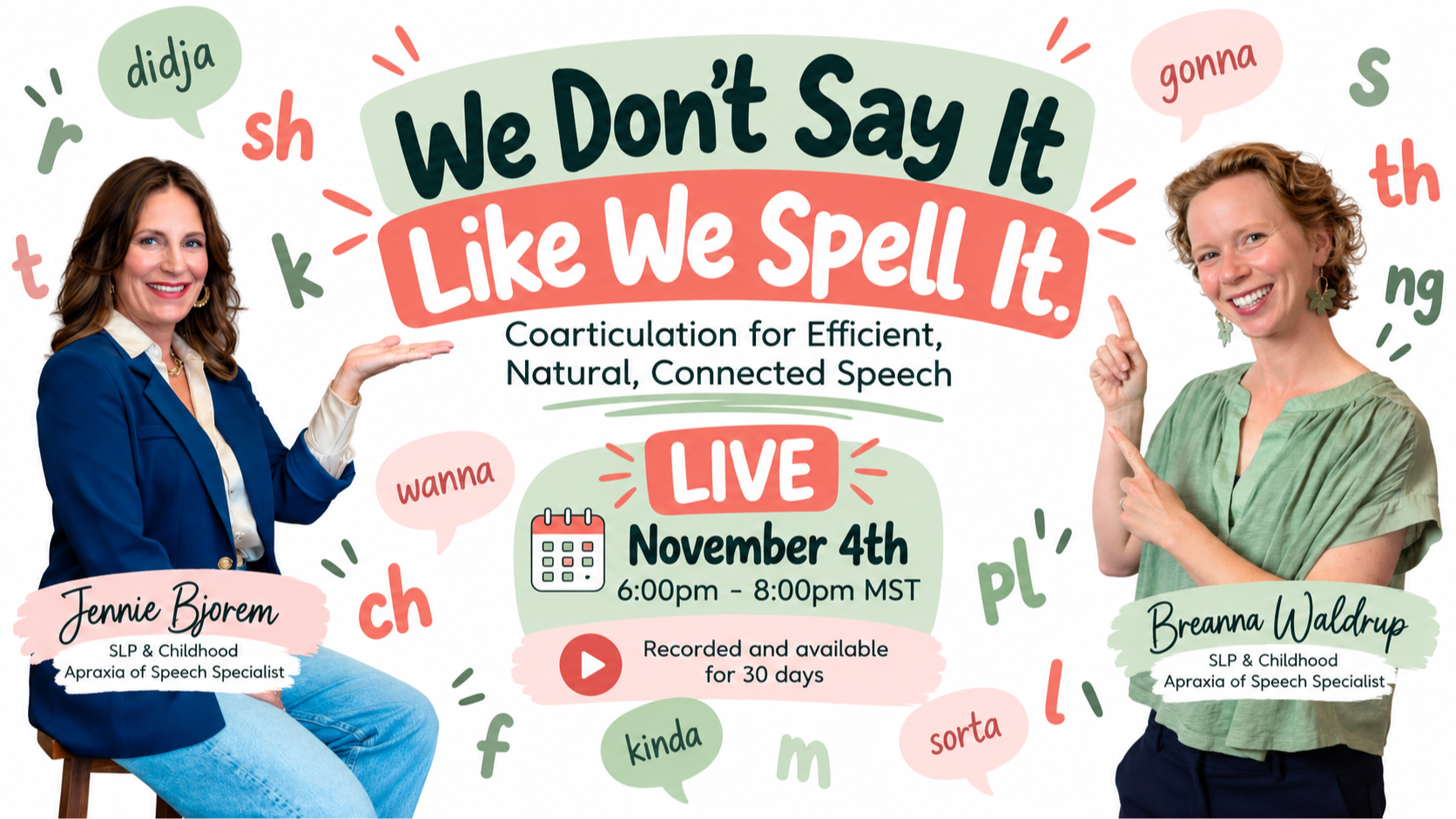
We Don't Say It Like We Spell It
Coarticulation for Efficient, Natural Connected Speech
LIVE with Jennie and Breanna November 4th 6pm MST
Recorded 30 day access
Presented by Breanna Waldrup, SLP, Childhood Apraxia of Speech Specialist & Jennie Bjorem, SLP, Childhood Apraxia of Speech Specialist
1.5 Hours of Instruction + 30-Minute Live Q&A (2 hours PDH)
This course is not for ASHA CEUs we offer a certificate for 2 PDHs
We don’t talk the way words are written, and we aren’t supposed to.
In natural, connected speech, we don’t carefully articulate every sound in every word. Our speech movements overlap. We anticipate what’s coming next. Sounds influence one another, movements are reduced or altered, words blend together, and our articulators are constantly finding efficient ways to move through speech.
This is coarticulation, and it is essential to efficient, natural, connected speech.
Yet in speech therapy, we can unintentionally teach children to over-articulate—producing every sound, separating words, or using exaggerated movements that result in speech that sounds choppy, effortful, or unnatural. For children with difficulty planning and programming speech movements, including children with childhood apraxia of speech (CAS), understanding how to facilitate efficient movement across connected speech is especially important.
In this highly practical course, Breanna Waldrup and Jennie Bjorem take coarticulation out of the phonetics textbook and put it directly into your therapy sessions. You’ll explore what actually happens when we speak connected English, including anticipatory and carryover coarticulation, assimilation, reduction, elision, linking, and the effects of stress and timing.
But this isn’t a course where you’ll leave with a list of definitions.
You’ll learn how to hear coarticulation, recognize when over-articulation is getting in the way, and make intentional therapy decisions that promote more efficient and natural speech movement. Through real examples, demonstrations, and immediately applicable therapy strategies, you’ll leave with techniques you can begin using with your clients in your very next therapy session.
Instead of listening only for “Did the child produce every sound?”, you’ll learn to ask:
“Is this an accurate, efficient, natural way to say it?”
You’ll leave understanding not only what coarticulation is and how English speakers use it, but exactly how to begin incorporating it into functional speech therapy.
Because our goal isn’t to teach children to pronounce speech the way words look on the page.
Our goal is intelligible, efficient, natural speech.
All Sales are FINAL, no refunds
